Translation Philosophy Overview
 This is the first installment in our "Bible Translation" series where we overview a few components of English translations of the Bible so that we may understand which Bible is the best for our use.
A great debate arising within conservative evangelical circles today is this: "What Bible Version should I use?"
Maybe someone says that the Catholic NABRE is the one, true, English translation. Then, one MacArthurian says that the LSB is the best English translation. Then, Pastor Blake from the non-denominational church down the road says that the NIV is the best. We at Grow Thereby use the Authorized King James Version. This begs the question...
Which one truly is The Holy Bible?
There are a few considerations to make regarding each English Bible. There are different original-text manuscripts, different philosophies on the philosophy of accurate translation, different readability levels, different societal acceptance, and more!
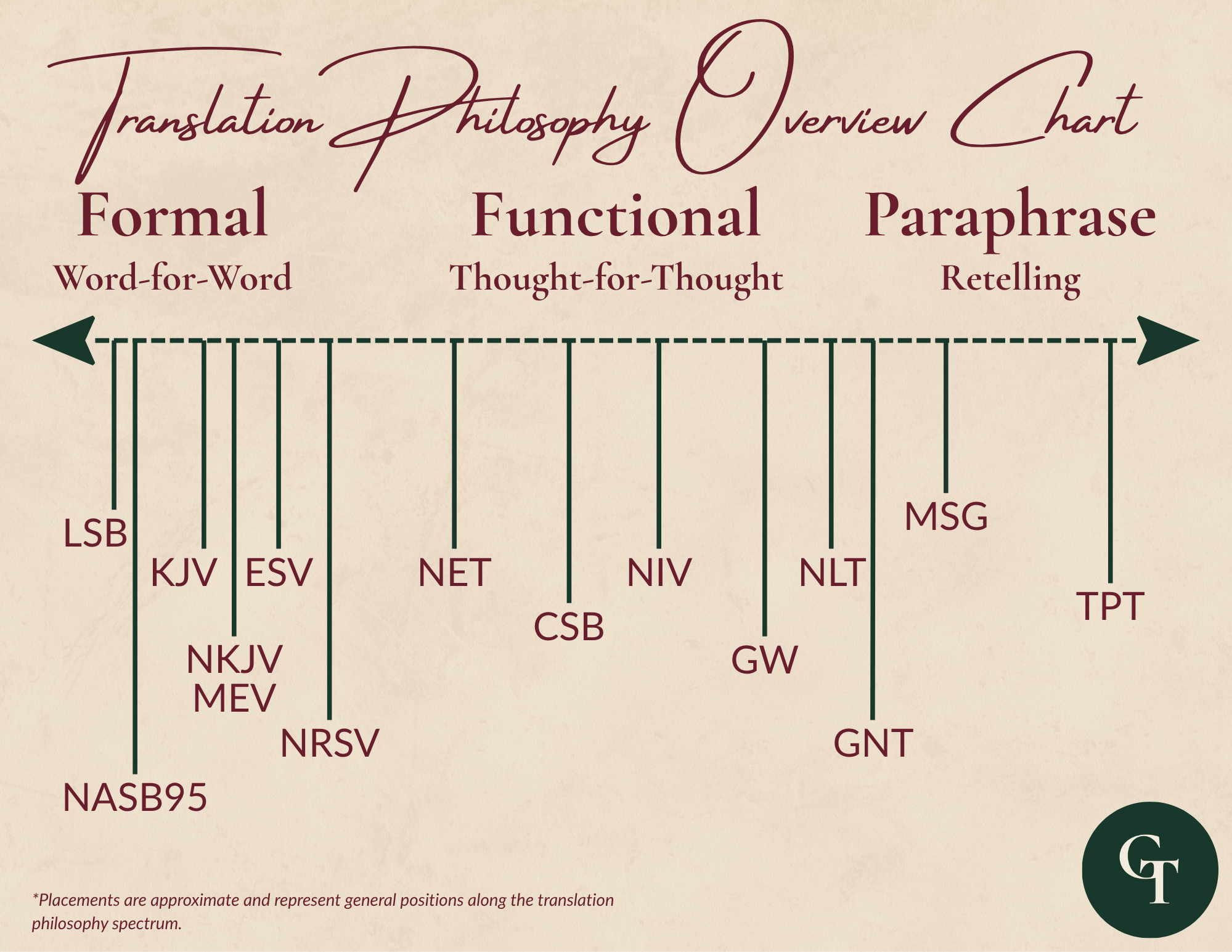
In this article, we at Grow Thereby have compiled a chart for your convenience to answer one of these considerations.
The Three Translation Philosophies
Formal Equivalence
Formal Equivalence is the fancy term translators use to describe a "word-for-word" translation philosophy. This is regarded as a very literal way to translate the original Hebrew and Greek manuscripts. This vein of translation philosophy attempts to preserve the very literal, grammatical words that the original authors scribed.
Functional/Dynamic Equivalence
Functional Equivalence is the "thought-for-thought" translation philosophy. This translation philosophy tries to bridge the gap between the grammar and words of the original language, versus our understanding of the intent of the words. This allows for a sacrifice of literalness for better understanding.
Paraphrase
A paraphrase translation is a retelling of the Bible. This translation also strives for readability and understandability in our modern English. Typically, these Bible versions have influence from other English translations. They are also typically translated by one singular translator, rather than a team of scholars.
Please utilize this chart by Grow Thereby to view where your choice of Bible translation falls on the scale of translation philosophy. You can download this chart for FREE to use, print, and have for yourself HERE!
*Grow Thereby does not endorse all the English Bible translations in this chart, rather this serves solely as an educational resource.